Applied Artificial Intelligence Tasklab
Poof. And Just Like That... It’s Gone.
The disillusion long predicted for AI has arrived, and it is financial. Nvidia’s plunge, Anthropic’s near-trillion in commitments and the circular economy behind the boom: the technology can keep improving while the money story comes apart.
Is an AI Disillusion Doom Upcoming? asked whether artificial intelligence was approaching Gartner’s infamous Trough of Disillusionment.
The argument at the time was relatively straightforward: the hype would eventually collide with reality, expectations would recalibrate, and meaningful applications would emerge from the wreckage of exaggerated promises.
That picture assumed a gradual recalibration.
Since then, the collision has become spectacular.
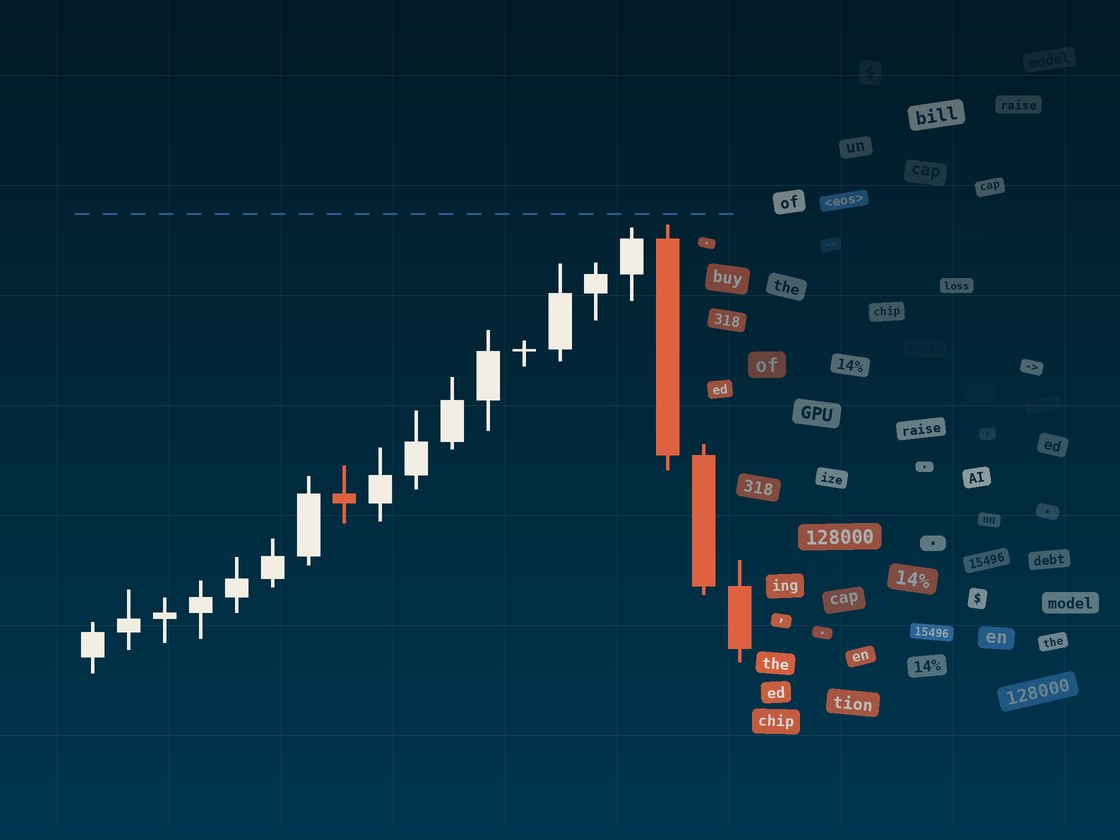
On Friday, November 20, Nvidia lost approximately 14% of its market value in a single trading session. The company that had become the gravitational center of the AI economy had fallen nearly 48% from its October peak, erasing more than $2.5 trillion in market capitalization.
The Nasdaq plunged 5.3%. The broader technology sector followed.
And Anthropic, whose historic IPO just a day earlier was supposed to restore confidence in the AI revolution, watched most of its initial stock market gains evaporate almost immediately.
Billions upon billions of dollars disappeared from valuations.
Poof.
And just like that... it’s gone.
The King Is Naked. And the Tailor Is Under Investigation.
For years, Nvidia represented something close to a financial certainty: whoever won the AI race would need computational power, and Nvidia would be there to sell it.
It was a beautiful proposition. Almost too beautiful.
While AI companies competed to build increasingly expensive models, Nvidia supplied the machinery, collected the revenue, invested in the ecosystem, and helped finance the infrastructure that would purchase even more of its hardware.
An extraordinary business. But also an increasingly interconnected financial arrangement in which the distinction between investor, supplier, lender, and customer became harder to follow.
Then came Jensen Huang’s resignation amid scandal, followed by reports of a Securities and Exchange Commission investigation examining potential accounting issues. An investigation is not evidence of wrongdoing, but the revelations arrived at exactly the wrong moment for an industry whose valuations rested so heavily on trust.
Suddenly, investors weren’t just asking how many GPUs Nvidia could sell.
They were asking who was paying for them, where the money originated, and whether the demand could sustain itself without constant financial reinforcement.
These are questions that were easy to postpone while the numbers kept rising.
Anthropic: The Most Expensive Experiment in Human History?
Perhaps the most revealing episode of this extraordinary week wasn’t Nvidia’s collapse. It was Anthropic’s arrival on the public market.
The creator of Claude went public on November 19 in the largest IPO in history, raising approximately $81 billion through the public offering alone.
It was supposed to be a triumph.
And in many respects, Anthropic has genuinely earned its place among the technological leaders of this generation. Its systems have demonstrated real capabilities, its enterprise adoption has been remarkable, and its revenue reached $33.2 billion in the first nine months of 2026.
This is not a company selling imaginary technology to imaginary customers.
But its prospectus revealed something even more extraordinary: approximately $900.9 billion in contracted future expenditure, overwhelmingly related to computing infrastructure, with $70.7 billion scheduled over the twelve months following September 2026.
Nearly a trillion dollars in commitments.
Pause on that number.
The company has raised enormous amounts of capital and possesses substantial liquidity. It even generated positive operating cash flow during the first nine months of 2026. Its failure is neither inevitable nor imminent.
But the sheer scale of its obligations raises an uncomfortable question:
What happens if artificial intelligence becomes cheaper faster than the companies building it can recover their investments?
What happens when a new model delivers comparable performance for a fraction of the inference cost? When open-weight alternatives become good enough? When enterprises discover that they don’t need the largest model for the overwhelming majority of their workflows?
Or, more simply, when growth remains extraordinary but no longer extraordinary enough?
Anthropic may survive, adapt, and become one of the defining companies of the century.
It could also become the most spectacular example of a business that successfully built the future but overpaid for the privilege.
The possibility of failure is not a verdict. It is precisely the kind of risk that euphoric markets tend to forget exists.
The Circular Economy of Artificial Intelligence
There is a particularly fascinating feature of this boom.
The companies building AI models buy computing resources from companies that invest in them. Infrastructure providers finance facilities that purchase chips from companies that, in turn, support the AI developers consuming that infrastructure.
Capital flows through the ecosystem, generating revenue, valuations, borrowing capacity, and more capital.
Some of that demand is unquestionably real. Some of those relationships are entirely legitimate and commercially sensible.
But when participants depend on one another’s continued expansion, the entire system becomes vulnerable to a simultaneous loss of confidence.
A dollar invested is not automatically a dollar of independent end-user demand.
And revenue supported by an increasingly elaborate financing structure is not necessarily evidence of a self-sustaining market.
This doesn’t make the AI industry a fraud. It makes its financial architecture potentially fragile.
The difference matters.
The question is no longer whether artificial intelligence can produce something valuable.
It can.
The question is whether it can produce enough value, quickly enough, to justify the capital committed in anticipation of its future.
These are two entirely different propositions.
An Obituary for the Infinite Growth Machine
Perhaps this is where the Trough of Disillusionment needs a second reading.
As a framework, it describes a psychological and technological phenomenon: inflated expectations meeting imperfect capabilities.
What is unfolding now may be something more consequential.
A financial reckoning in which the technology continues improving while the economic assumptions supporting its expansion deteriorate.
Models will continue to improve. Algorithms will become more efficient. Smaller models will challenge larger ones. Open ecosystems will evolve. Intelligent systems will become increasingly embedded in ordinary software, industrial processes, and daily life.
None of that requires a perpetually rising Nvidia stock price.
None of it guarantees that today’s most valuable AI companies will still dominate tomorrow.
The history of technology is full of revolutions that transformed civilization while destroying extraordinary amounts of investor capital.
Railroads changed the world. Railway investors still went bankrupt.
The internet changed everything. The dot-com crash was still real.
A technological revolution can succeed even when its financial architects fail.
And maybe that’s exactly what’s beginning to happen.
The Intelligence Remains. The Illusion Doesn’t.
There is a certain irony in watching an industry obsessed with building artificial intelligence discover that it may have been insufficiently intelligent about its own economics.
For years, the prevailing strategy was remarkably simple: raise more capital, acquire more computing power, build a larger model, promise a more extraordinary future.
The assumption was that the returns would eventually justify the expenditure.
Perhaps they still will.
But the era in which the promise itself could justify almost any expenditure appears to be ending.
And for anyone building artificial intelligence systems, this may be excellent news.
Because beneath the financial spectacle lies a much more interesting industry.
One concerned with measurable productivity rather than benchmark theater. With efficient architectures rather than computational extravagance. With ownership, interoperability, specialized models, useful datasets, and applications that solve identifiable problems.
An industry in which intelligence is an engineering capability, not merely a financial narrative.
That piece closed on the idea that the journey of artificial intelligence was far from over, that it was merely entering a more lucid phase.
That still holds.
But lucidity can be brutal.
The eulogy here is not for artificial intelligence. Nor, at least not yet, for Nvidia or Anthropic.
It is for the comforting belief that limitless technological potential guarantees limitless financial returns.
For the notion that more computing power will always mean more value.
For the idea that the future can be purchased indefinitely with someone else’s capital.
The machines are still here.
The algorithms still work.
The problems worth solving haven’t disappeared.
But the magic trick that made every promise look like a trillion-dollar business?
Poof.
And just like that... it’s gone.
Trends